
Developers, Elected Officials, CAAC’s, Wannabes…Bring Us BS, And We’ll Sniff It Out!
NO BS #2 – ‘Community Liason Committee’
This article appears in the August 2026 issue of the MPCA newsletter, regarding the CLC:
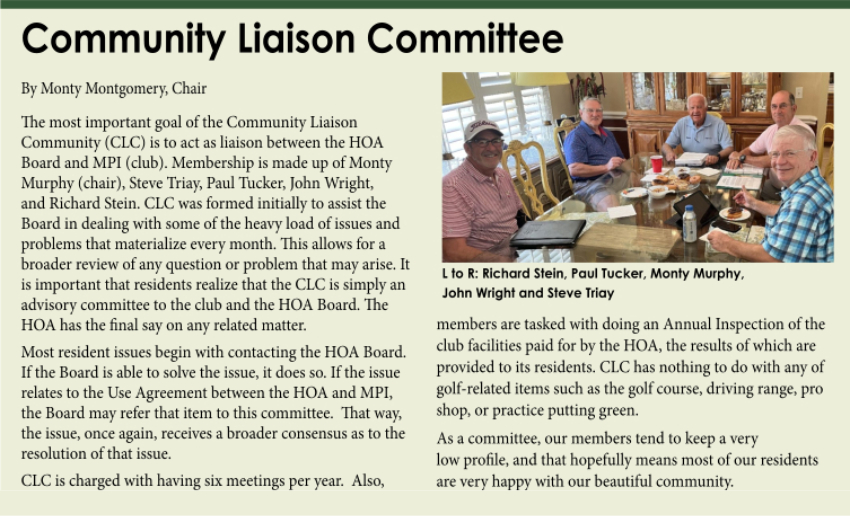
The article states that ‘CLC was formed initially to assist the Board in dealing with some of the heavy load of issues and problems that materialize every month. This allows for a broader review of any question or problem that may arise.’ It adds, ‘Most resident issues begin with contacting the HOA Board. If the Board is able to solve the issue, it does so. If the issue relates to the Use Agreement between the HOA and MPI, the Board may refer that item to this committee. That way, the issue, once again, receives a broader consensus as to the resolution of that issue.’
While there’s no question that we have a ‘heavy load of (club) issues here, do ‘most’ residents get satisfaction by noticing the board on these? Do we know if, in fact, ANY issues relating to the Use Agreement have been referred to CLC? Ever? Anyone care to back that up with some facts? Now the puzzling part, what exactly does ‘…the issue, once again, receives a broader consensus as to the resoultion of that issue’ mean? Well, once that ‘consensus’ is reached, when, if ever, has a ‘resolution’ of one, or more, or any of the ‘heavy load’ of issues been reached? Documented? Reported to the community?
We know the board famously pronounced the club in violation of the agreement last year, adding publicly, that the club would be notified, yada, yada. That information was on our homepage for months, and the disappeared without a trace or explanation during the holidays.
Regarding ‘[CLC] members are tasked with doing an Annual Inspection of the club facilities paid for by the HOA, the results of which are provided to its residents.’ Okay, the CLC has produced 3 reports so far this year; in the last one, in April, based on a ‘current and very clear photo’, the dilapidation of the bulkhead on Red #3 was noted, and that the club as notified. That was the only ‘problem’ from the ‘heavy load’ of club issues reported this year.
‘Reported this year’…that’s interesting, as the CLC, for a living, breathing committee is noticeably absent from (unnumbered) ‘page 2’ of the newsletter. And since we’re all dressed up here, we might as well delve a little into some other notable aspects of CLC’s performance YTD.
-
-
- The committee has had a slow and delayed start to its formal meeting cadence. They had “no action to report” in February, and their meeting on April 1, 2026, was explicitly designated as their “First Meeting of 2026”. (Prior meetings in late 2025 were informal and only attended by the Chairman). Having held only one formal meeting in the first four months of the year, the committee will need to meet frequently in the remaining months of 2026 to achieve its six-meeting mandate.
- The committee’s progress on its core ‘Liaison and Advisory’ roles is currently stalled. Although the Chairman met informally with MPI in late 2025 to discuss key issues like the length of the agreement and MPI’s reluctance to provide a Certified Profit & Loss statement, negotiations hit a standstill due to “completely different” legal opinions from each party’s attorneys. By April 2026, the committee acknowledged it was in a “hold pattern” pending a final legal resolution between the Club and the HOA.
- The August article clarifies an important operational boundary to prevent resident confusion: the CLC “has nothing to do with any golf-related items” (such as the course, driving range, pro shop, or putting green). Their focus remains strictly on the community-funded physical facilities. Why is this qualification even required, and bolded. Surely, we residents have been fully pummeled with this distincition over the years, why remind us now? Or, is this published for the benefit of the developer in any possible legal action to defend their promised revenue stream from attack by rogue residents?
-
Inspection Report 9/24/2026
While the 2015 Agreement established clear, high-quality, and proactive baselines for the clubhouse, pool, and tennis courts, the inspection reports reveal that these baselines have degraded. Faced with an aging facility and rising operational costs, the CLC has shifted its priority from auditing MPI’s contract compliance to justifying MPI’s limitations to a frustrated resident population.
An analysis of the Community Liaison Committee (CLC) Inspection Reports from 2024, 2025, and 2026 against the contractual mandates of the 2015 Club Use Agreement reveals a significant evolution in the physical state of the facilities, a narrowing of operational scope, and a dramatic shift in the CLC’s regulatory tone.
The CLC has transitioned from a rigorous consumer-advocacy group holding ownership strictly accountable to an advisory body that manages resident expectations and defends the Club’s management. The following is a summary of the last three years’ CLC Inspection Reports, all three (though the committee charter calls for 2 per year); the comparison of scope, emphasis and priorities is the real story here. All three are compared to the mandate of the (current) 2015 Use Agreement.
Contractual Mandates vs. Inspection Scope
Under Section 4(c) of the 2015 Club Use Agreement, Magnolia Point Investments (MPI) is contractually obligated to operate and maintain the pool, clubhouse, parking area, children’s playground, and tennis courts in an “acceptable state of repair and functionality” that is “aesthetically appealing” according to the strict guidelines in Appendix D.
Clubhouse Standards: Appendix D requires interior painting to repair chips and dings every six months, well-maintained kitchen equipment, and landscaping that creates a “favorable impression”.
Tennis Court Standards: Appendix D mandates that the seven tennis courts be maintained to U.S. Tennis Association (USTA) Standards, with smooth, level, and well-drained surfaces (no standing water), daily grooming, tight nets, and fully operational lights across all courts at all times.
The “In-Between” Facilities: The Pickleball Court is notably absent from Appendix D. It was installed later “to test the market” and was never contractually protected under the 2015 Use Agreement.
Inconsistencies and the “Slipping” Maintenance Bar
A critical reading of the reports across the three-year period reveals stark inconsistencies in how facility conditions are reported, pointing to a lowering of standards rather than actual structural improvements:
The Sudden Tennis Court Reversal (2024 vs. 2025):
In 2024, the inspection painted a dire picture of the tennis facilities: the boundary lines were bowing and crooked (a direct USTA violation) causing three people to trip and fall, the fencing had 15 broken joints left untouched “for years,” courtside trash receptacles were broken, and the court lighting was deemed “insufficient” to the point that local captains refused to play evening matches. Additionally, 5 tennis teams had abandoned the club due to high associated fees.
In 2025, the report abruptly claimed the courts met USTA standards, the wind screens were fine, the lines were clear, the nets were tight, and the lights were “new LED”.
The Inconsistency: It is highly improbable that MPI completely overhauled the entire tennis infrastructure, re-aligned the concrete boundaries, fixed the fencing, and resolved the lighting issues within twelve months. Instead, the 2025 report introduces a defensive preface: “While we all like new and shiny things, our community is not new and shiny…some consideration must be given to the age of the club”. This shift suggests the CLC chose to lower its grading bar to match the facility’s aging realities rather than holding MPI to the strict “aesthetically appealing” standard of Appendix D.
The Quiet Abandonment of Pickleball:
In 2024, the single, unlit, unfenced pickleball court had 12 stress cracks.
In 2025, the CLC softened its language, framing the court as a temporary “market test” and noting that the decision to repair or remove it was “entirely up to MPI”.
By 2026, the court was described as being “in bad shape” with widening cracks and was officially recommended for complete abandonment because ownership decided to drop plans for expansion. Because Pickleball is not contractually mandated in Appendix D, the CLC and MPI simply allowed the facility to deteriorate to the point of failure.
Clubhouse Neglect: Appendix D’s requirement for 6-month interior paint touch-ups and high-quality maintenance has been consistently bypassed. In 2024, a Pro Shop countertop remained unfinished for three years. In 2025, the Parlor suffered from active A/C leaks, mold, and walls blocked with dirt. By 2026, the clubhouse entrance was plagued by persistent wasps and mud daubers and required fresh paint, which the CLC excused as an “age factor” rather than a maintenance failure.
Changes in Scope, Emphasis, and Priorities
The focus of the inspections has drifted significantly, wavering between over-stepping contract boundaries and retreating to narrow definitions:
The Golf Scope Confusion:
The 2015 Use Agreement explicitly states that residents’ fees do not apply to the golf facilities.
In 2024, the CLC ignored this boundary, dedicating space to “Other Topics” like advocating for golf-perk buy-one-get-one (BOGO) deals, resident golf lesson promotions, and first responder/veteran discounts.
In 2025, the CLC corrected this, explicitly stating that “Nothing related to golf was a part of our inspection tour”.
However, in 2026, the CLC backslid, dedicating a large portion of its “Maintenance” section to golf course vandalism (golf carts doing “donuts” on the greens and chemical damage) and auditing the Golf Shop staffing and beverage stock.
Shifting Tone: From Community Voice to Owner’s Apologist
The most dramatic change is in the attitude and role of the CLC itself. Chartered to act as the “voice of the community” and to “monitor compliance with the terms of the agreement”, the committee’s stance has inverted:
2024 (John Cardinell, Chair) – The report was demanding and transparent. It called out safety hazards (tripping on tennis lines), listed 14 specific required upgrades (canopies, net replacements, water lines, fence repairs), and openly critiqued management’s pricing structure for driving away local tennis teams.
2025 & 2026 (Monty Murphy, Chair) – The CLC’s primary focus shifted to defending MPI and managing resident complaints:
Excusing the 2026 Pool Closure: When the pool was shut down by the Health Department in 2026 due to a major pump failure, Mr. Murphy used the inspection report to defend the Club’s management and actively debunk residents’ complaints online, calling it a “simple expensive mechanical failure” and outlining the logistics of shipping a replacement from California to Texas to Florida to show the club was doing its best.
The Vandalism Deflection: In 2026, the report introduced a major emphasis on “heartbreaking vandalism” committed by community members (such as broken restroom doors, sliced rental waterslides, and golf course damage) costing \$2,000 per month. While vandalism is a legitimate issue, the CLC used this narrative to frame normal maintenance as a “heavy daily burden on the owner”.
Instead of holding MPI accountable to the strict standards of the Use Agreement, the CLC’s priority shifted to policing the community, warning residents to stop posting on “different internet sites” and telling them, “If you see something, hear something, say something!”.
Summary
While the 2015 Agreement established clear, high-quality, and proactive baselines for the clubhouse, pool, and tennis courts, the inspection reports reveal that these baselines have degraded. Faced with an aging facility and rising operational costs, the CLC has shifted its priority from auditing MPI’s contract compliance to justifying MPI’s limitations to a frustrated and disillusioned resident population.
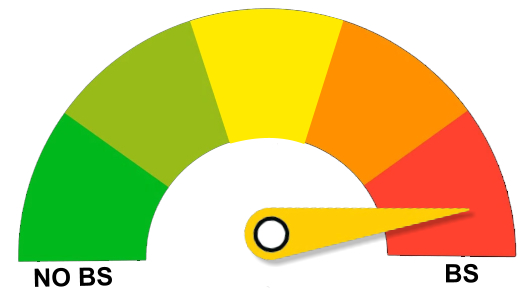
For publishing ‘Community Liaison Committee’, suggesting it’s a viable, credible, productive and useful committee benefitting the residents of Magnolia Point, we rate this article: